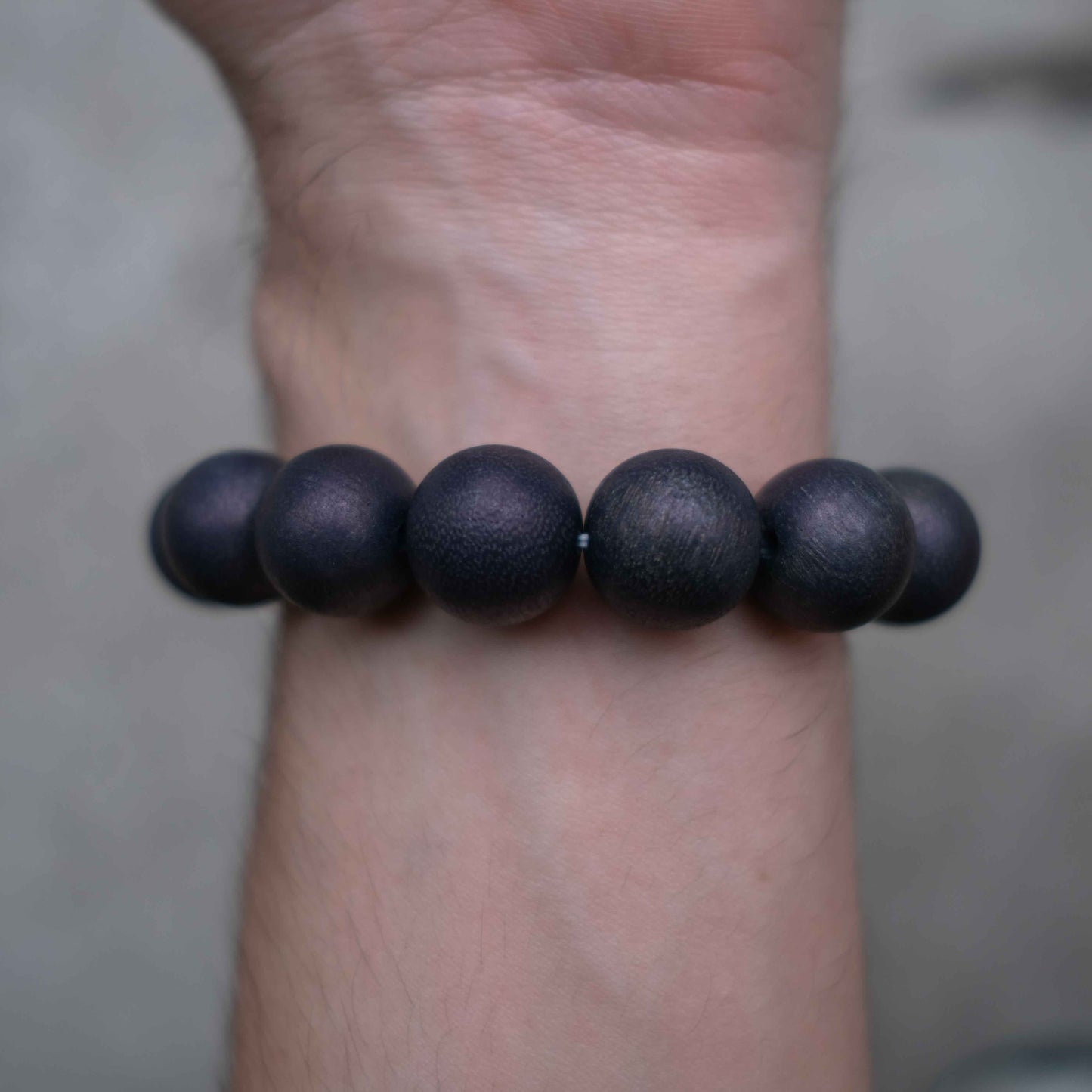
Indigo Dye Japanese Wooden Beads Bracelet 15mm
- Dyed by hand with natural dyes
- Entirely made and dyed in Japan
Couldn't load pickup availability
Japanese wooden beads bracelet dyed with natural Japanese sukumo indigo in my studio in Tokyo. Indigo is known to coat wood very well with a beautiful dark blue color. Each beads is 15mm and each type of wood has a different texture or pattern. The bracelets are available in three wrist sizes, so please measure the circumference of your wrist before purchasing.
All wood used for these beads is from Japan and processed into round beads at a local factory in Osaka.
Materials; Japanese natural wood, elastic rubber band.
Please note that some spots on the beads might get a little lighter over time, but the overall color will stay blue.
- Japanese Trees Made out of well known Japanese trees like cherry blossom or pine.
- One of a kind Each pair is hand-dyed by me in my studio in Tokyo.
- All natural dyes No chemical waste water and chemical dyes reaching our skin and pores.
International Shipping
All products are shipped internationally by Japan Post Services with tracking. The rates are based on the weight of your order. For example, the international shipping rates to Europe start at 1,240 yen (€6,75 / $7,75) for a package of 200 gram which equals two pairs of socks.
Please keep in mind that the shipping rates will increase when the weight of your order increases.
For an accurate rate of your shipping costs, please add your desired products to your shopping cart, fill in your address and check the rates before check out.
Japan Shipping
Japan Shipping
All products are shipped domestically by Japan Post Services with or without tracking. The rates are based on the weight and size of your order. For example, a pair of socks can be shipped for 210 yen without tracking, or for 430 yen with tracking. For orders that are of bigger size, I will use yuu packet.
Please keep in mind that the shipping rates will increase when the weight of your order increases.
For an accurate rate of your shipping costs, please add your desired products to your shopping cart, fill in your address and check the rates before check out.
Product Care
Product Care
Natural dyed items require a little more attention and love when washing and handling these items. To keep your colors as bright as possible, please pay attention to the following washing instructions.
-How to wash-
It is recommended to launder with ph neutral detergent, which is neither acidic nor alkaline. Some natural dyes are sensitive to unbalanced acidic and alkaline ph levels. Using unbalanced PH detergent could fade or shift the colors of your product.
Both hand wash and the washing machine are fine to use.
Hand wash:
Dissolve a small amount of neutral detergent in lukewarm water and gently press and wash. Keep in water for 15 minutes and done!
Washing-machine
A normal spin with ph neutral detergent is completely fine.
After laundering, immediately reshape and flatten the garment, then dry in the shade (natural dyes are vulnerable to the sun and ultraviolet rays, there please dry your garment inside or in the shade).
Please launder separately from white or light-colored items as natural colors may bleed.

Natural Dyes
Natural dyes are all fully biodegradable and won’t harm the environment. They do not create chemical waste water and chemical dyes reaching our skin and pores. Natural dyes are non-toxic to the maker and the user and less likely to cause allergic reactions. In certain cultures it is believed that natural dyes like Japanese indigo protect the wearer of insects and give a cooling feeling.
Japanese Trees
These beads are made out of well known Japanese trees like the cherry blossom or buddhist pine which are often seen in Japanese gardens. I also use trees from the massive Japanese forests like the pine tree or sacred cedar of mt. Koya. The trees are processed by hand into round beads at a small wood factory in Osaka.
Japanese Supply Chain
I make and source all my products in Japan. By having a local supply chain, I minimise transportation-related emissions and have control and close contact with my suppliers. Besides, Japanese made products have a strict quality control and value craftsmanship.